

How To Repair A Tree From Beaver Damage
 Interior Wall Coverings
A Guide to Building Age & Choices of Wall Capsule or Coverings Indoors
- Mail service a QUESTION or COMMENT nearly ages & types of wall & ceiling materials, installations & practices
InspectAPedia tolerates no conflicts of involvement. We take no relationship with advertisers, products, or services discussed at this website.
Guide to beaverboard, drywall, plaster & paneling on interior walls:
Ages & types of terminate materials used for interior walls & ceilings: here we provide a photo guide to identifying types of plaster, lath, Beaver board, Upson Board, and Drywall to help identify these interior edifice wall and ceiling coverings and as an aid in determining the age of a building.
This article discusses the identification and history of older interior edifice surface materials such plaster and board, Beaverboard, and Drywall - materials that were used to form the (usually) not-structural surface of building interior ceilings and walls.
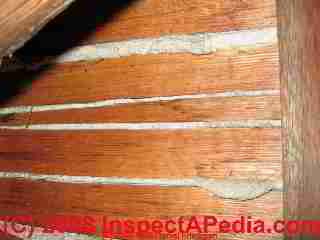
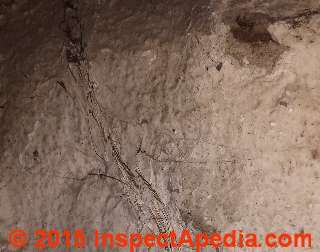
Our page top photo shows manus-split wooden board bankroll for a plaster interior wall.
We also provide an ARTICLE INDEX for this topic, or you tin endeavor the page top or bottom SEARCH BOX as a quick mode to detect information y'all demand.
Guide to Plaster & Drywall & Other Interior Wall Coverings as Indicators of Edifice Age
Article Series Contents
- DRYWALL, FIBERBOARD, PLASTER INTERIORS
- ASBESTOS CEMENT CEILING & WALL PANELS
- ASBESTOS in DRYWALL - separate commodity
- BEAVERBOARD - separate article
- UPSON Board - MDF used as interior sheathing and in many other applications from puzzles to oil paintings
- COATING TYPE CEILING & WALL SURFACES: CATALOG OF
- DRYWALL & GYPSUM Lath - separate commodity
- DRYWALL IDENTIFICATION STAMPS - carve up article
- FIBERBOARD SHEATHING - split article, Beaverboard, Nu-Forest, Insulite, and many others on building exteriors & interiors
- GYPSUM BOARD PLASTER LATH SYSTEMS
- HARDBOARD BATHROOM & KITCHEN PANELS
- MASONITE & HARDBOARD CEILING & WALL COVERINGS
- METAL LATH for PLASTER
- PANELING, WOOD & WAINSCOTING
- PLASTIC INTERLOCKING Bath TILES
- SACKETT BOARD
- UPSON Board
- WOOD FIBRE INSULATING PANELS
- WOOD LATH for PLASTER or STUCCO - separate article
Above we show a photo of hand-split woods lath and plaster wall, from the wall-cavity side. Ca 1800. In that location are several generations of plaster and board, plaster board, and drywall which have been used in buildings.
[Click to overstate whatsoever image]
History of Types Interior Plaster: carve up forest lath, sawn wood lath, expanded metal lath, "rock board" or plasterboard, drywall, & tainted Chinese drywall
The age of a building can be determined quite accurately by documentation, just when documents are not readily available, visual clues such equally those available during a professional person home inspection tin still determine when a house was built past examining its components, building materials, even nails, fasteners, and types of saw cuts on lumber.
Nosotros name and illustrate these and talk over their periods of use below equally an aid in finding out how old a building is and tracing its history.
Asbestos Cement & Fiber Cement Fireproof Ceiling & Wall Panels
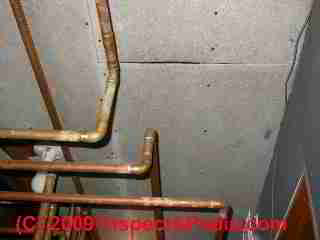
Asbestos-cement panels and later on non-asbestos-containing fiber-cement panels were widely used as fireproof coverings for walls, ceilings, even floors in various applications such as in boiler rooms as well equally in chemical laboratories and other areas where an inert, durable, fire-resistant surface was needed.
See CEMENT ASBESTOS Canvas PRODUCTS for the age, history of and details about cement-asbestos fireproof panels used in and on buildings.
History of Beaver Board & Upson Board Wall Coverings in North America
Beaver-board and Upson Board are a wood cobweb product used as an inexpensive interior wall roofing and draft blocker from about 1903 when Beaver Board was invented past J.P. Lewis in Beaver Falls, NY, to the 1950s, with its near-twin product Upson Lath continuing in use into at to the lowest degree the 1980's.
Our photographs (below) testify this production from it's dorsum or wall cavity side. On the exposed side this wood fiberboard product was usually painted and its joints covered with wood lath or other trim.
In some applications Beaverboard or UpsonBoard was covered with wallpaper. Still later in the life of many buildings where Beaver Board was installed it was later covered with drywall to provide a more burn-resistant surface.
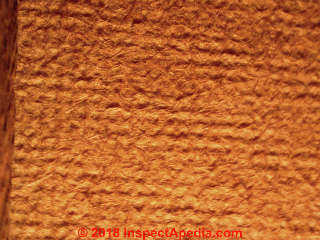
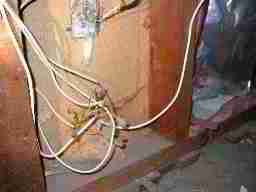
Beaverboard takes its name from the Beaver N.Y. and the Beaver Board Companies that produced this product until that firm was purchased by Certain Teed Prod cuts in 1928. Beaver Board and Upson Lath were produced past the Beaver Wood Fibre Company Express, in Thorold, Ontario.
Beaver board's competition was from Upson Processed lath (John Upson, Upson Company, Lockport, NY) which was produced showtime in 1910.
As late as the 1950's Upson Board was used in prefabricated houses and exterior building capsule and in recreational vehicles.
Upson purchased the Beaver Board plant from CertainTeed in 1955. Upson began its decline in the 1970'due south and closed in 1984, opening afterward that year as Niagara Fiberboard.
Beaverboard and other paper or fiberboard products were used for exterior wall sheathing, every bit we show in this photograph at left.
How to Identify Beaver Board

Beaver Board was marked on the back of each canvass with an ink-stamped trademark and make.
Details most BeaverBoard used on interior walls and ceilings are constitute
at BEAVERBOARD in our article on building sheathing materials identification.
Upson Board Identification

Upson Board, a medium-density fiberboard made from recycled wood fibers, embossed its marking into the board itself, and a "Blue Center" (illustrated below thanks to one of our readers) runs through every piece of the board.
Run across details now found at
UPSON Board - MDF used as interior sheathing and in many other applications from puzzles to oil paintings
Ceiling & Wall Covering Materials Using Plaster, Drywall / Gypsum Board, or Stucco
This listing of mutual ceiling and wall coverings is in guild roughly past historic period or history of utilize. Information technology is thus not in alphabetical society.
- Mud used as a plaster over split forest lath or woven woods lath
An instance of mud plaster is below in this article
at MUD PLASTER
- Horsehair mixed with plaster or cement for building exterior wall covering.
A photograph of horse pilus plaster is shown here, courtesy of an InspectApedia.com reader who had this material tested for asbestos - which was plant to be absent.
Meet PLASTER INGREDIENTS, MIX, COMPONENTS for details about this early plaster textile.
- Plaster of paris applied in at least two layers,a rough brownish or scratch glaze and a smooth white plaster top coat over paw split or sawn woods lath.
Two coat and three-coat plaster on lath systems are detailed
at PLASTER TYPES & METHODS in BUILDINGS
- Plaster wall or ceiling coverings of the aforementioned general formula was after applied
over EXPANDED Metallic LATH
See PLASTER Blazon IDENTIFICATION for a photo guide to different plastering systems used in buildings for walls, ceilings, and fireproofing..
- Gypsum Board / Gyp-Rock / Stone Lath: Plasterboard with round holes punched at regular intervals substituted for the plaster scratch coat, nailed to wall studs, eliminating the wood board requirement. A peak glaze of plaster was applied to the plaster board.
"Ears" of oozing plaster pushed through the round holes helped hold the plaster tiptop coat in place. Essentially synonymous are drywall, gyp stone, gypsum lath, plasterboard when used as a backer for a summit coat of plaster.
For details almost gypsum board used as a plaster base
run into GYPSUM BOARD Board
Sackett Board
Above: probably Sackett Board, a USG production start produced by Usa Gypsum after USG'due south buy of the Sackett Plaster Board Company in 1909.
- Sackett Board: Sackett Lath, first produced by the Sackett Plaster Board Company, was formed of multiple layers of paper and plaster such every bit the production shown in our reader photo to a higher place.
The Sackett Lath appears to take been top-coated with a layer of plaster.
Sackett Board was probably the first gypsum-board product widely-used as a wall and ceiling covering, typically meridian coated with a stop-layer of plaster.
Encounter SACKETT Lath for details.
- Stucco wall & ceiling coatings on interior surfaces may be installed every bit traditional stucco, a cementious product, or as a stucco look-alike using textured paints or coatings including drywall or plaster.
See SIDING EIFS & STUCCO - topic home, for a detailed article serial near this textile and its use on both exteriors and interiors of buildings.
- Drywall, a lighter gypsum formula, with joints taped with paper (subsequently fiberglass or plastic mesh) and coated with articulation chemical compound. Available in one/4", 3/8", 1/2", and three/4" thickness, typically 4' x 8' or4' ten 12'. Before drywall was secured with drywall nails;
Modern drywall is secured to wall studs using machine-driven drywall screws or in some applications mucilage likewise as drywall screws.
The composition of modern drywall or gypsum lath is given
at DRYWALL & GYPSUM Board
Also see DRYWALL IDENTIFICATION STAMPS
Gypsum Board Lath Sheets Used for Plaster Walls & Ceilings = Rock Lath, Plaster Board, Stone Lathe & Button Board
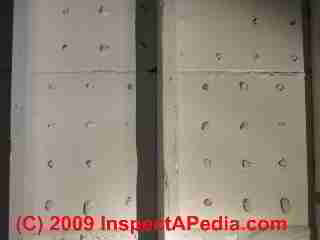
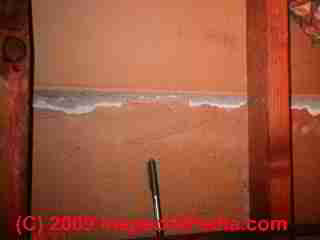
Our photograph (above left) shows perforated gypsum board panels that were used equally plaster board.
Solid gypsum board (above right, without holes) was also used every bit a support for a plaster finish coat. Often this textile was practical in two-foot widths - a characteristic that the inspector may spot by noticing scalloped ceilings and walls or fifty-fifty cracks that appear regularly on 24" centers.
According to some patent disclosures (given below on this page) non-perforated gypsum board panels used every bit a plaster base of operations included versions with depressions or indentations to better-receive and attach the plaster top coats.
At PLASTER TYPE IDENTIFICATION nosotros include more-detailed give-and-take
of GYPSUM Lath PLASTER Lath SYSTEMS - perforated or solid gypsum boards as plaster base of operations:
"Rock lath", including the history of use of "rock lath" or perforated gypsum board or "button lath" as a plaster base or board-substitute material.
Expanded Mesh Metal Board for Plaster Walls
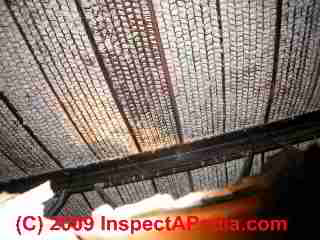
Our photograph shows expanded mesh metal lath used every bit plaster lath support for ceilings and walls; this material was also used on building exterior walls to back up a stucco finish. Metallic lath was on occasion used also to support poured concrete ceilings (shown here) - unlikely to provide acceptable forcefulness for a thick pour unless additional reinforcement was used.
Depending on building age we may find a mixture of multiple types of plaster support, forest lath, gypsum board lath, and metal lath. Wall or ceiling or stucco scissure patterns may follow the borders of metal lath segments, especially if the lath was not securely nailed.
See PLASTER LATH, METAL for details about the types, uses, & installation of expanded metal lath.
See PLASTER Blazon IDENTIFICATION for details about plaster used in or on buildings. .
Masonite™ and Other Hardboard Interior Wall & Ceiling Products: Identification
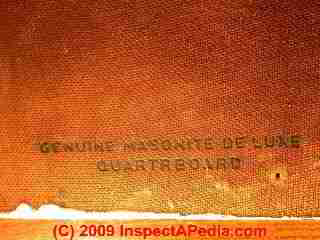
Masonite hardboard panels are oftentimes found every bit a utility cladding in buildings on walls and ceilings. This article explains the utility usage of hardboard interior products, and nosotros exclude wood or wood-like wall or ceiling paneling products.
Those are discussed
at HISTORY of the Use of Woods & OTHER WALL PANELING in North America.
History, more photos, & dates of the invention, production, & use of Masonite™ and similar hardboard products are
at HARDBOARD MASONITE™ & OTHER BRANDS
Bathroom & Kitchen Laminated Hardboard Panels
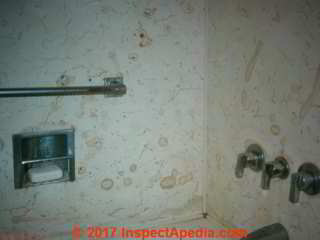 Laminated Masonite® and other hardboard products take been widely used every bit water-resistant panels to cover walls and sometimes ceilings in bathrooms, kitchens, and other piece of work areas.
A hard thin plastic laminate was applied to the hardboard surface to simulate marble, tile, or other materials.
Laminated hardboard was widely used in other applications besides, including baby piece of furniture, lab surfaces, RVs, cabins, ornamental wall wall coverings simulating tile, in various pre-fabricated structures, and even in some automobile door panels and airplane panels.
Cleverly the U.S. regular army used a shipping crate for latrine parts that combined tempered Masonite or the like panels that formed a lining to convert the aircraft crate to a latrine enclosure. (Sheffield 1955).
Above: laminated hardboard equally a bath tub surround in an older U.Due south. dwelling. Scratches or nicks in the surface of the hardboard allow water to penetrate, causing the nighttime brown ringed stains at this tub surround.
Other water penetration in older hardboard wall coverings can cause the formation of a roughened or rippled surface.
When water damage is severe the hardboard softens, swells, and may leak into the wall cavity.
See as well IDENTIFY Masonite™ and other hardboard Canvass and Siding Building Materials
Because of its lighter weight and alternative production means hardboard-based wall and ceiling coverings found a place where previously cementious products such as asbestos cement or later fiber cement board was used on walls and ceilings as a fireproof wallboard.
Too see CEMENT ASBESTOS SHEET PRODUCTS
Beneath: another coated Masonite® type hardboard used around a bathroom tub.
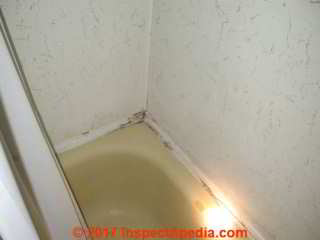
History, Research, Examples of Unitized Bathroom Wall & Ceiling Coverings & Tub Surrounds Using Coated or Laminated-Surface Hardboard
- Tenunon, Charles Chiliad., "Edifice unit." U.S. Patent 2,130,911, issued September 20, 1938.[Using cementious material or fiber cement or asbestos cement board - a precursor to the products discussed higher up]
Excerpts:
It has been proposed heretofore to form building units to simulate brick of regular outline with horizontally and vertically extending mortar spaces or mortar simulating lines but such constructions are not capable of use in simulating material of irregular outline such every bit the uneven edges of stone, rubble or cleaved slate.It has likewise been proposed to course shingles and siding with irregular edges simply these edges are complimentary and tend to curl up or to exist displaced by the wind.
Floor such as linoleum is sometimes formed to simulate broken flagstones or the like but such materials are expensive and are not adjusted for use on open up porches or in courtyards and similar locations where it is exposed to the weather.
- Nilson, Stanley E., "Shower cabinet." U.S. Patent 2,423,722, issued July 8, 1947. This patent was originally assigned to the Fiat Metallic Mfg. Co. describing an earlier sheet-metallic shower enclosure.
- Sheffield, Frederick T., "Shipping crate for latrine fixtures convertible into complementary latrine structure." U.S. Patent ii,712,164, issued July 5, 1955.
- Gick, James E., "Ornamental tile and method of fabrication." U.Due south. Patent 2,982,042, issued May 2, 1961. [Using ceramic tile bonded to Masonite type hardboard]
Excerpts:
In the conventional structure of a tile panel having a relief design with a mosaic background, for example, the relief design is incorporated in 1 or more ceramic plaques much larger than the private mosaic bodies, and the plaque or plaques are cemented to a base member along with the mosaic background bodies.Such a construction is relatively expensive for a number of reasons.
...
As heretofore stated, the relief design D is customarily embodied ina-'=ceramic plaque which is also bonded to the base member, being made of linocellulose difficult lath which is commercially bachelor under the trade name Masonite. - Male monarch, Bernie Eastward., "Unitized bathroom structure." U.Due south. Patent 3,110,907, issued November 19, 1963. This patent was assigned to the Rohr Corporation.
Excerpt:Equally may best exist seen in FIGS. 3, 4-and 8, the bottom of tub 20 is reinforced with a tempered Masonite'board'57 then that any weight concentrations applied to the lesser surface 56 of the tub are evenly distributed over its surface area.
In the tub floor construction as shown, a reinforced plastic layer is applied to a higher place and below the Masonite lath 57, the upper layer "56 of which is formed concurrently with the fabrication of the same gel coat 43 and reinforced layer 47 of plastic shell 28.
The Masonite board '57 is so applied to this initial plastic layer 56 and the additional layer, or outer plastic lesser layer 58 of the tub, is thereafter applied to the lath 57 to thus completely encapsulate the board within the reinforced plastic.
- Wokas, Albert Fifty., "Prefabricated bathrooms and prefabricated restrooms." U.S. Patent 3,162,863, issued December 29, 1964.
Excerpts:
This invention relates to the prefabrication of rooms, especially restrooms which may or may not contain baths. It is particularly concerned with the prefabrication of ii restrooms which are built together as a unmarried unit package prepare for installation in a edifice.These package units are made up of walls, floors, ceilings, doors, and completely equipped interiors, including all the plumbing fixtures, water lines, and waste lines in place, tested and gear up for employ when the bundle units are delivered to the sites.
- Dobija, Michael J. "Tub surround." U.S. Patent iv,109,426, issued Baronial 29, 1978. This patent was assigned to the Masonite Corporation. Excerpt:
A tub surround includes first and 2d identical corner sections and first, second and third identical panel portions. The tub surround is assembled by positioning a first panel between the two corner sections thereby defining one wall. The remaining panel sections are joined with each of the corner portions to define second and third walls.
Each corner section includes first and second legs extending at correct angles from each other.
The ends of the legs extending from the corner sections prevarication on a plane parallel to and separated from the plane of each side thereby defining a joint behind which the edges of the panels may exist positioned. The corner sections further include shelves extending between the legs of the corner sections.
 @Ty:
@Ty:
If by "safe to telephone call this wall covering asbestos" you mean" is it very likely that I'yard right and it'southward an asbestos material: my reply is no, we have no footing to know what that fabric is from your photo alone,
simply
If by "safe" you mean "am I erring on the safe side by treating an unknown wall-roofing fake tiles as asbestos" - certain, it's always "safer" to treat an unknown cloth equally possibly hazardous.
If yous look at the material more-closely you may see that information technology is actually a wood-based fiberboard or hardboard product laminated with a plastic or vinyl skin to resemble tile - every bit that was a very mutual wall covering.
At our clarification of Masonite-type hardboard products found
at HARDBOARD MASONITE™ & OTHER BRANDS
we include the1960s magazine advertizement for interior bath Masonite™ temprtile wallboard shown above. Temprtile was a hardboard-backed wall coverd with a laminated plastic "skin" roofing simlating ceramic tile, installed by gluing sheets of the surfaced hardboard to the original walls.
At our description [in a higher place on this page]
we notation that
Laminated Masonite® and other hardboard products have been widely used as h2o-resistant panels to cover walls and sometimes ceilings in bathrooms, kitchens, and other work areas.
A hard thin plastic laminate was applied to the hardboard surface to simulate marble, tile, or other materials.
Meanwhile, take a closer look at the edge or at any points of wear or damage to see if you can place chocolate-brown woody fibrous backerboard - and attach a sharp photo of what you find hither as a page bottom "Comment".
Sentinel out: some floor and wall roofing adhesives also contained asbestos - avoid making a dusty mess.
Those details are at ASBESTOS-CONTAINING MASTIC DANGEROUS?
Is it safe to say that this material contains asbestos? Might exist difficult to tell from merely ane prototype
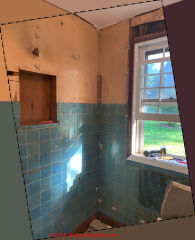 @Ty,
@Ty,
Certain it's safe to cover that old faux-tile wall material, but have care get-go to satisfy yourself that there were no leaks into the wall cavities as there could be a hidden mold problem; the time to find and clean up whatever leak impairment is exactly now rather than later when the bathroom has been finished.
Beginning time home buyer and bought a house that was built in the 1930's and remodeled around 1960. We have seen there is asbestos flooring in parts of the house but my question is most a recent finding during a bathroom demo. The blue tile is in a sail of vinyl with no specific dimensions. It has a circular or flower like agglutinative on the back of the sheet. Is information technology safety to say this is asbestos? Is information technology safe to cover?
[Photo above]
This Q&A on possible asbestos in faux or "imitation" bath or kitche wall tiles was posted originally
at ASBESTOS Flooring IDENTIFICATION
Interlocking Plastic Wall Tiles
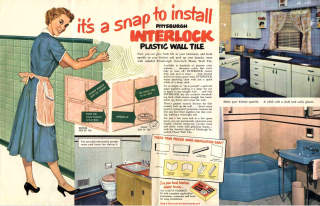 Some 1950s and 1960s "false" bathroom and kitchen walls were covered using interlocking plastic tiles produced by companies using this new "space-historic period" material
Shown here is "Pittsburgh Interlock Plastic Wall Tile" first patented in 1943 (Pauli) and popular in North America from the 1940s through 1960s, probably virtually-often as a retrofit wall roofing in existing bathrooms when homeowners got tired of repairing or re-painting water-damaged walls.
Plastic interlocking kitchen and bath tiles were, mayhap, a more than-durable culling to HARDBOARD BATHROOM & KITCHEN PANELS in areas where water splashing was probable.
In the U.S., Pittsburgh enjoyed a long and historic role in the evolution of bathroom and kitchen wall tiles in the U.Due south., making it no accident that the Pittsburgh Interlocking Plastic Wall Tile product originated there.
While the start ceramic tiles in the U.S. were probably produced by the US Pottery in Bennington, Vermont, it was the Pittsburg Encaustic Tile Company who had the first commercial success with ceramic wall tiles beginning in 1876.
These central patent disclosures aid u.s. assign possible dates to homes where plastic interlocking wall tiles are or were used. For old firm restorers who like plastic wall tiles yous may find some of these products notwithstanding for sale as "antiquarian" building products on web-stores like eastward-Bay.
- Pauli, Jr Charles D. WALL TILE [PDF] U.S. Patent 2,323,417, issued July 6, 1943.
Extract: My invention has for its primary object the provision, as a new article of manufacture, of a compact, light-weight, durable tile of homogeneous synthetic plastic, which may be conveniently applied to and upon a wall, which is uniquely provided with interlocking members for enabling rigid, h2o-proof securement of the tiles together and in place on a wall, which may be efiiciently and economically made past loftier-product molding methods and to substantially whatsoever desired shape without distortion and strain, and which is highly satisfactory in the operation of its intended functions.
[Editor's note: my mother Teal, entertaining herself while expecting, glued tiles like this to what was my future bath wall after I was produced in September of the same year.]
- Brown, Richard K. INTERLOCKING WALL TILE [PDF] U.S. Patent 2,490,577, issued December half-dozen, 1949, filed by and assigned to the Pittasburgh Plastic Tile Visitor
Excerpt:The tiles preferably are made of a plastic suc has polystyrene although they may exist made of other materials. The tiles are affixed to a wall past applying a gob of mastic cement to the rear face of the tile and pressing the tile confronting a wall.
- Lopina, Joseph J. INTERLOCKING PLASTIC TILE [PDF] U.S. Patent 2,627,744, issued February 10, 1953.
Extract: It is an object of this invention to provide tile which dispenses with the need for the mastic defining beadsv between the bordering tiles thereby eliminating the expensive wiping operation and enabling the utilise of cheaper mastics as substantially all of the mastic used in the mounting of my novel tile is concealed by the tile themselves.
- Luster, Carl J., and Richard G. Dark-brown. INTERLOCKING WALL TILE [PDF] U.S. Patent two,693,102, issued Nov 2, 1954. filed by and assigned to the Pittasburgh Plastic Tile Visitor
Excerpt:
The present invention relates to interlocking wall tile and more particularly to improvements in the structure and shape of the tile and the interlocking formations thereof. Interlocking tile as heretofore commercialized is illus trated by United States Letters Patent ii,323,417, issued July 6, 1943, to Charles D. Pauli, Jr., and ii,490,577, issued December 6, 1949, to Richard G. Chocolate-brown.
Wood Lath Systems Supporting Plaster or Stucco in Older Homes: Hand split up vs. Sawn Woods Lath
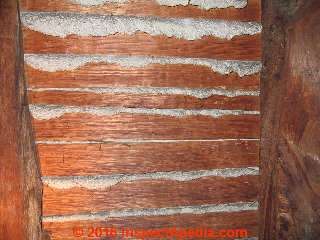
Above and also in some other photograph shown earlier in this article series, we include a photograph of hand-carve up wood lath and plaster wall, from the wall-cavity side of a U.S. home congenital around 1800. In that location are several generations of plaster and lath, plaster board, and drywall which have been used in buildings.
Details about the types of wood lath used to support plaster or stucco on building walls, ceilings, or exteriors are
at WOOD LATH for PLASTER or STUCCO.
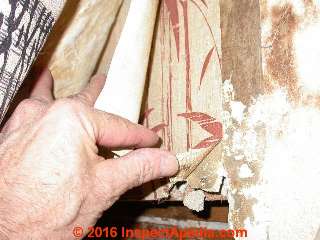
Inspecting old interior walls with care can yield interesting and perhaps useful historical information well-nigh the structure. Below I'm demonstrating that this plaster-board wall too sported four layers of wallpaper atop the originally-plastered wall surface.
History & Types of Forest and Wood-Production Wall Paneling in Due north America
Early Colonial Wall Paneling & Wainscoting
Early colonial paneling is described by Isham.
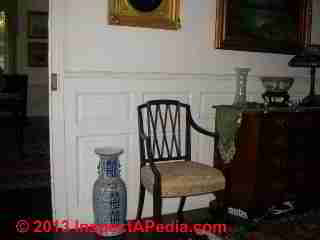
A concise history of wall coverings in residential buildings, more photos, & dates in process, CONTACT us, contributions invited.
Shown at left, colonial style wall paneling in the historic Suffolk Resolves Business firm (1774) in Milton MA.
Wainscot Wall Covering
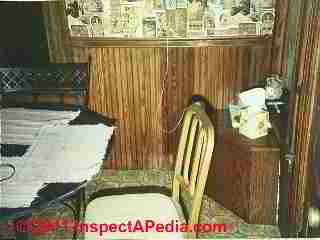
Definition: Wainscoting or "wainscot" is a wood wall terminate applied to the lower portion of a edifice interior, typically most three to 4 feet up from floor level, and commonly capped with a chair track and commonly applied with board edge joints butted vertically as in our photo.
Traditional wainscot is constructed past nailing private boards to the wall surface. Modern "wainscot" panels are sold in 4' 10 eight' sheets and cut to fit, producing a beadboard surface that looks like traditional wainscot.
Wainscot is an old term, possibly from the 1300's, that in its contemporary usage derives from the British Wainscot, "a fine grade of oak imported for woodwork" - Merriam Webster.
In Northward America wainscot has been in use since the colonial era.
Our photograph (left) illustrates beadboard blazon wainscot wall paneling in a Victorian home congenital in Poughkeepsie, NY in 1900.
Wooden wall paneling - tongue and groove pine and other forest
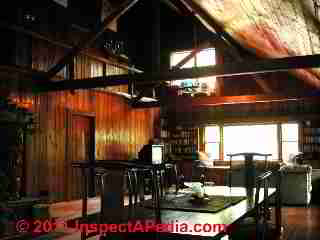
Wooden wall paneling made of individual boards, often natural language-and-groove common or knotty pino, was most often nailed vertically from flooring to ceiling and finished with wall trim at both of those levels.
In North America solid 3/4" thick 5-grooved vertical tongue-and-groove pine paneling on edifice interior walls was particularly pop from about 1945 through the 1960's.
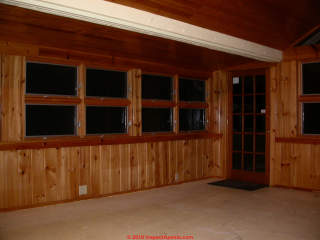
Above: 3/4" thick pine boards installed as pine paneling past the author in a Poughkeepsie NY home.
 Can someone please tell me the name of this dated wall finishing technique and possibly suggestions on how to update information technology without taking abroad from its character? Thanks very much
Georgette,
I meet custom wood wall paneling using horizontal boards made from crude-cut lumber sawn to retain the original profile of the tree from which the boards were sawn; I have not constitute a special proper name for this custom design.
While at that place are other sliced wood wall hangings and paneling designs yours may be unique and in my opinion well worth preserving.
However informal names include:
Wood-Slice wall paneling, Woods Tree Slice Wall Paneling, Sliced Log Wall Paneling, Horizontal Log Piece Wall Paneling.
For in-make full between the horizontal log slices we see in your wooden wall paneling, information technology appears that solid forest, probably a laminate or plywood was used as a backer panel over which the horizontal log slices were glued or nailed.
Without knowing what you lot have in listen by the word "update" I can't make a suggestion for reserving the walls as shown other than to leave them alone. Certainly painting the surfaces or interlacing with drywall would be in my view a travesty.
Yous could consider changing the floor covering and furnishings to items more consonant with the room'due south original pattern.
In a most-extreme effort you could disassemble and lightly sand the log slices and all of the wood paneling to obtain a lighter colour without giving upward the woods paneling design and its special rough-cutting tree shape feature.
Please tell u.s.a. the country and city where this building is located and the age of the building and its type.
Also take a expect
Readers who take more than to say most this paneling are invited to POST a QUESTION or Comment below on this page.
Wall paneling in 4' x 8' sheets
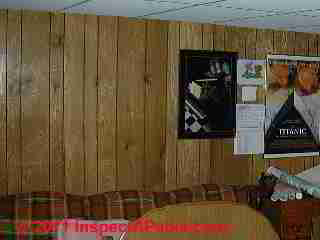
By the 1970's in the U.Due south. and Canada, the use of solid tongue-and groove wall paneling was more oft replaced by thinner four' x 8' sheets of wood veneer paneling sections.
Shown above is a typical thin plywood veneer type wall paneling installed in the 1970's. A curtailed history of veneer-type wall paneling in residential buildings, more photos, & dates in process, CONTACT us, contributions invited.
Also see Sheathing, FIBERBOARD ASBESTOS CONTENT
More examples of wood wall paneling designs are
at PANELING, Forest, OTHER where we testify examples of custom woods paneling and horizontal log piece paneling.
Hardboard, MDF & Composite Wall Paneling
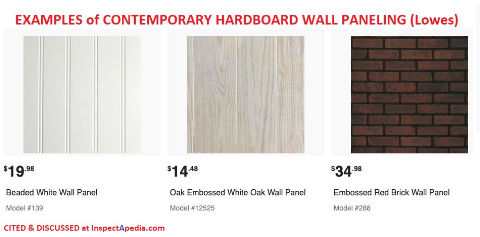
A wide range of more than 50 pop smooth, textured, and grooved hardboard wall paneling products sold in sheets, typically four' 10 8' continues in popular apply in North America, Australia, New Zeland, and Europe. Like to plywood-based wood paneling, hardboard panels are provided in various surface designs and colors of which a few examples are shown in a higher place, excerpted from Lowes building supply website in 2022.
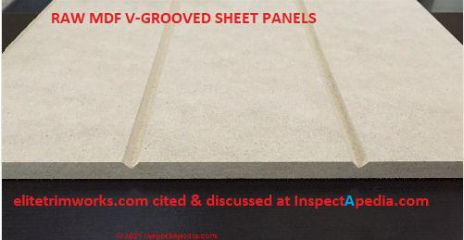
Similar interior wall and ceiling panels of softer MDF and fiberboard have been in popuar use since at lest the 1940s. A modern example, in "raw" or un-coated form, is shown beneath.
 ...
...  ...
... 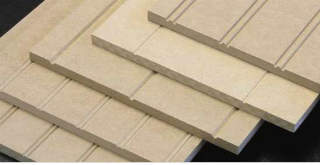
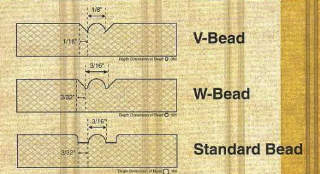
To a higher place: iii detailed photos of MDF paneling as provided by Canadian supplier EliteTrimworks
The panels above are also used in cabinetry and other interior applications.
Similar wall paneling produccts are sold so in these categories, all like in external or finished advent:
- FRP / Fibergoass-Reinforced Plastic Panels
- Hardboard wall & ceiling panels
- Polyurethane wall & ceiling panels, false marble and other surface appearances
- PVC wall & ceiling panels
- V-Grooved Raw MDF paneling like the product shown in a higher place, from EliteTrimworks (elitetrimworks.com)
- Vinyl wall panels
- Wainscoting Panels - beadboard, of whatsoever of these materials
- Wood or plywood-based wall & ceiling panels
Current installation methods for these wall or ceiling panels
- Adhesive-ony paneling
- Adhesive and rivet paneling
- Nails and adhesive paneling
- Nail-up paneling
- Peel-and stick paneling
MDF Paneling Resources
- EliteTrimworks, 25 Purple Group Cres #8 in Woodbridge (Toronto), ON., L4H 1X9 (on the SW corner of Hwy 7 & Hwy 27) Cost Gratuitous 888-898-1665 Website: https://www.elitetrimworks.com/ Tel: 905.760.1665
- Georgia Pacific, DECORATIVE WALL Console INSTALLATION INSTRUCTIONS [PDF] (2009) retrieved 2022/02/08 original source: https://images.homedepot-static.com/itemize/pdfImages/3a/3aaa9eb1-fc8c-41d8-9d0c-bb37963be415.pdf
- WallDesign, MDF WALL PANEL Apply & Care INSTRUCTIONS [PDF] retrieved 2022/02/08 original source: https://images.homedepot-static.com/catalog/pdfImages/1e/1ed66aa5-4780-4c2b-a0d8-0272830fd84f.pdf
- WallDesign, MDF WALL Console USE & INSTALLATION INSTRUCTIONS [PDF] retrieved 2022/02/08 original source: https://images.homedepot-static.com/itemize/pdfImages/6c/6c9d8f3d-ee27-4971-83ce-ead7cd00129e.pdf
Forest-Lath Plaster Systems
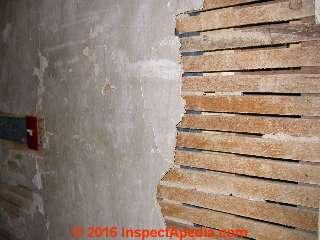
Above photograph shows the more-regular width sawn wood board used to support plaster in a dwelling constructed ca 1865. Details about wood-board plaster systems are
at Wood LATH for PLASTER or STUCCO - divide article
Drywall Limerick, Ingredients, History
This data is now on its own page:
DRYWALL & GYPSUM Board
Identifying Stamps on Drywall Used for Interior Wall & Ceiling Surfaces
This word has moved to this separate folio:
DRYWALL IDENTIFICATION STAMPS
Also see additional drywall identifying number stamps found
at DRYWALL GYPSUM BOARD Used for Outside Wall Sheathing.
Where in that location indoor environmental concerns or corrosion damage to electric wiring, copper pipes, air conditioning equipment, etc. be sure to
see CHINESE DRYWALL HAZARDS.
Drywall Gypsum Board Used for Exterior Wall Sheathing
Details are noq at EXTERIOR USE GYPSUM BOARD
and at SHEATHING, GYPSUM Board
As well see DRYWALL MOLD RESISTANT for an interior drywall reported to resist mold growth.
Reader Q&A - besides see the FAQs serial linked-to beneath
@Brandy Billington,
Is the back of that material blackness asphalt-like impregnated paper?
Is the fabric very paper-thin or is information technology thick like linoleum flooring? (It looks like an asphalt-backed canvass flooring or asphalt-paper backed wallpapr)
What is its thickness? Show me an border and a back view.
Trying to determine what this is. The house is 70yrs old and originally done in shiplap.
So this was placed over it with peradventure wall paper then wood paneling.. Earlier I dig into it more, I would only like to know what information technology is.
Thank yous very much for your help!
I'm pretty certain that that is a medium density fiberboard paneling.
This is what the dorsum of the paneling looks similar if information technology helps whatsoever..
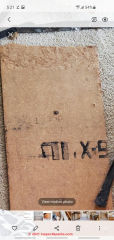
I believe the house was built in 1976. Not sure that's when paneling went upwards though. I didn't measure it, will measure out when nosotros go back adjacent calendar week to do more than piece of work on the house, but if I had to gauge, I'd say 1/2" or a little less. It's not particularly hard, aptitude a bit with crowbar before breaking. Not sure you can tell, simply it has a wood grain look to it.
Calculation:
If you know the historic period of the paneling that would be helpful.
Hi, nosotros recently purchased a home built in 1976. The owner did some quirky things. I'm trying to find out what this paneling is and if it could take asbestos in it. Thank you lot very much for any assistance!
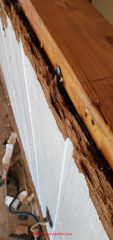
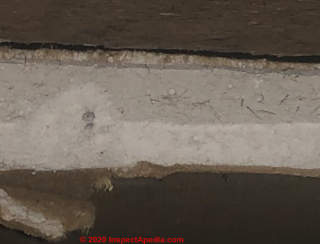 Thank you Jake, that sure looks like a single piece of drywall or gypsum board.
We can but think that you have spotted a disontinuity in the production run mix of filler. That sort of matter does happen in manufacturing as we've seen in a range of products such as cobblestone roofing. The product line runs continuously but the mix of incoming ingredients may vary.
Simply from the 1970s finding creature hair in what looks similar conventional drywall would be quite odd.
That's surely an older plasterboard.
Asbestos was used in some but not all such products so, unfortunately, from eyeballing it alone we can't say if your plasterboard contains asbestos.
If y'all find any stampings or markings or remains of an identifying newspaper strip, frequently establish at the ends of the drywall, that'd exist interesting, but it looks as if all that was torn off.
For other readers:
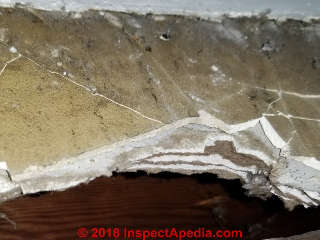
Higher up a closeup of the gypsum board or drywall or plasterboard nosotros're discussing, excerpted from Jake'southward earlier photo.
Here is a picture show of the whole piece. The perspective is looking upwardly at the floor joists in the basement.
The board is sandwiched between the HVAC ductwork and the joists. It is ane/2" thick and the paper is actually thick and has a fine near woven/dimpled texture.
I of my thoughts is that it is a heat-resistant product given where they installed it.
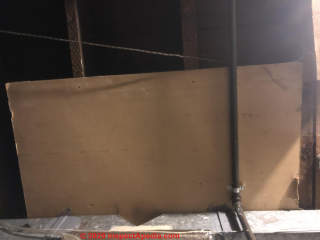
That said, in that location are a lot of rough patches in this house, so this may just exist a random canvass of building textile they used to provide a surface to mount the gas line to the furnace. The lath could be as old as the late 70s, when the original furnace was put in.
Even if information technology is a gypsum product that just looks weird on one end, are there whatsoever old gypsum lath products that incorporate hair-like material in the core?
Interesting: the two ends look similar different materials and different ages.
Are you confident you're looking at two ends of the exact-same material - with no butted, perhaps hidden, seam or joint?
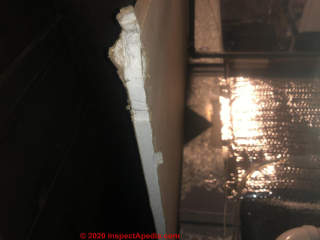 Thanks! I have attached a 2d image showing the other exposed cross-section, which appears to be a gypsum-similar material with no fibrous elements (compared to the gray department in the other end, which appeared to take some kind of embedded fiber).
Does the variation across the two exposed ends (2 different materials visible on one side and one material visible on the other) suggest a manufacturing defect (maybe it was supposed to exist two layers throughout)?
That difference is what threw me off.
The firm is from 1900 in Mansfield, MA, U.s.a..
This is the only identify in the house where I have found this material.
The walls that I have worked on are either board-and-plaster or modern drywall hung over the erstwhile lath.
Thanks for the photo and plaster lath question, Jake;
That looks similar a plaster board that was used to support a stop coat (the white layer) of plaster as a substitute for wood or metal lath.
See PLASTER TYPES & METHODS in BUILDINGS
for identification keys, photos, guides.
Also permit us know the country and city and age and type of edifice in your photo.
I have come up across what I think is a wall covering product in my basement that seems dissimilar from everything discussed here. The only place information technology is used is sandwiched betwixt the hot air supply duct and the floor joists higher up.
It has thick brownish newspaper and the material inside appears to be variable.
On one exposed cease it looks similar there is a layer of horsehair plaster and a layer of gypsum (all encased in the newspaper) withal the other exposed end looks like a elementary gypsum core.
I would like to remove it so I can clean up the expanse effectually and in a higher place my furnace and appropriately address whatever deficiency this seemingly slapdash effort was intended to fix (a lot of that in this house...) , but I would similar to know what I am dealing with offset.
If possible, I volition postal service a few more pictures. If I tin can practice simply one, this is the exposed stop that appears to show 2 different detached materials sandwiched between the brown paper.
Dick
I apologize for having to give a glib-sounding answer only sure, paneling of all sorts has been used in buildings to cover all sorts of conditions for centuries.
There is specific reason to assume that paneling is being used to comprehend asbestos unless nosotros know more about the building, its construction, materials, history of ecology concerns and events.
Was Panelling used to cover Abestos in bldgs in the late 1960s. And is the picture attached a water leak.
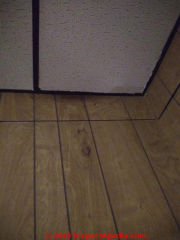
I'thousand doubtful that you're glue will bond successfully to those surfaces merely yous probably could agree the fiberboard or other insulation in place with furring strips
My husband purchased his grandparents home that was built in the mid 70s. It has a detached garage that was finished on the inside. When we had them re-sided, my step son's crew damaged the exterior sheets of fiberboard when pulling off the one-time siding on the garage.
This "fiberboard" is like paper-thin crossed with corkboard.
It is soft. I don't really know what to phone call it. Anyhow, when attaching the new siding, they didn't e'er hit studs, so there are loose nails and holes where it broke through.
I want to use the leftover insulation boards cut down to fit in between the studs, simply I know that the nails will probably push out. Can I glue them to keep them in place?
Priceton
That looks every bit if a plaster skim coat is failing over the plaster brown coat. The cleft blueprint suggests that the failure is due to either loftier interior wet (a hidden leak somewhere?) or poor original work.
Remove all of the loose cloth and if the base surface is sound and secure, and so re-plaster the surface beneath.
Paints peeling off this material in entire home. What is it and can it be refinished
I'm remodeling a basement storage room that had water harm from to a higher place chief-flooring leaking window, poor roof gutter pattern and probably some side by side unfinished crawl space moisture.
Previous owner semi-improved part of UNF basement into storage room with cheap (70s style) 4x8 forest veneer paneling.
Working with Insurance visitor, which says they will simply reimburse for original wall paneling unless I can bear witness that paneling does not meet current building codes.
Does the old wood paneling withal satisfy typical residential edifice and remodel lawmaking requirements ?
Would like to only replace with moisture/mold resistant drywall/hardi-board etc.
Any other thoughts and considerations would be appreciated.
That looks like brushed cedar paneling; A wire brush is used to remove the soft wood, leaving the exposed hardwood as raised ridges.
Lookalikes were manufactured of other materials every bit well.
I am trying to identify the type of wood panel this is in our upstairs room.
Nancyh0001@gmail.com
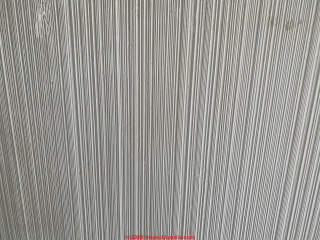
I can see much but it looks like a fiberboard product. Run into details
at FIBERBOARD Capsule IDENTIFICATION .
Tin anyone give me information on this material thanks
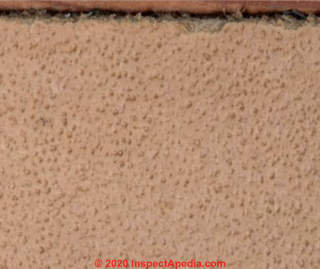
Anon:
By and large cellulose - wood-based products don't contain asbestos though in that location were some exceptsions, probably traced to cross-contagion, discussed
at SHEATHING, FIBERBOARD ASBESTOS CONTENT
that could too appear in an interior wall product.
Does wood paneling iv*8 grooved with a hard surface which resembles wood terminate information technology looks similar it is laminated to partilce board year 1968 and is nailed to the interior walls in my hallway in my firm practise these panels comprise asbestos?
Does woods veneer type panels from from year 1968 which is nailed to the interior wall in my hallway comprise asbestos?
...
Continue reading at FIBERBOARD CEILING & WALL COVERINGS or select a topic from the closely-related manufactures below, or see the complete ARTICLE Alphabetize.
Or see DRYWALL, FIBERBOARD, PLASTER INTERIOR FAQs - questions & answers posted originally on this page.
Or meet these
Recommended Articles
- DRYWALL, FIBERBOARD, PLASTER INTERIORS - abode
- ASBESTOS CEMENT CEILING & WALL PANELS
- ASBESTOS-DRYWALL REMEDIATION / REMOVAL
- BEAVERBOARD
- BESTWALL DRYWALL ASBESTOS
- CELOTEX DRYWALL ASBESTOS
- CELOTEX HISTORY & PRODUCTS
- CHINESE DRYWALL HAZARDS
- COATING TYPE CEILING & WALL SURFACES: CATALOG OF
- DOMTAR GYPROC ASBESTOS?
- DRYWALL & GYPSUM BOARD COMPOSITION & HISTORY
- DRYWALL CONTROL JOINTS
- DRYWALL CRACK CAUSES
- DRYWALL Cease LEVELS
- DRYWALL IDENTIFICATION STAMPS
- DRYWALL INSTALLATION Best Practices
- DRYWALL INSTALLATION HORIZONTAL vs VERTICAL
- DRYWALL Dark-green LOW TOXICITY MAGNESIUM OXIDE MgO
- DRYWALL MOLD RESISTANT
- DRYWALL MOLD TESTING
- DRYWALL NAIL POPS
- FIBERBOARD CEILING & WALL COVERINGS
- FIBERBOARD Console REPAIR
- FIBERBOARD SHEATHING - abode
- FIBERBOARD Capsule IDENTIFICATION
- GYPSUM Lath GYP Stone Capsule
- GYPSUM Lath PLASTER LATH SYSTEMS
- HARDBOARD BATHROOM & KITCHEN PANELS
- HOMASOTE HISTORY & PRODUCTS
- IGNIFUGE GYPSUM BOARD ASBESTOS?
- MASONITE & HARDBOARD CEILING & WALL COVERINGS
- METAL Board for PLASTER
- NATIONAL GYPSUM DRYWALL ASBESTOS?
- NU-WOOD PANELS
- PANELING, Wood & WAINSCOTING
- PLASTER TYPES & METHODS in BUILDINGS
- PLASTER INGREDIENTS, MIX, COMPONENTS
- PLASTERBOARD / DRYWALL EXPANSION COEFFICIENTS
- SACKETT Board
- Capsule, GYPSUM BOARD
- SUNDEALA Lath COMPOSITION & HISTORY
- UPSON Board
- WALL FINISHES INTERIOR
- WOOD LATH for PLASTER or STUCCO
Suggested commendation for this spider web page
DRYWALL, FIBERBOARD, PLASTER INTERIORS at AuditApedia.com - online encyclopedia of building & environmental inspection, testing, diagnosis, repair, & problem prevention communication.
Or encounter this
Alphabetize to RELATED ARTICLES: Article INDEX to Edifice INTERIORS
Or employ the SEARCH BOX found below to Ask a Question or Search InspectApedia
...
Ask a Question or Search InspectApedia
Questions & answers or comments nigh ages & types of wall & ceiling materials, installations & practices.
Endeavour the search box just below, or if you prefer, post a question or comment in the Comments box below and nosotros volition reply promptly.
Search the InspectApedia website
Note: appearance of your Comment below may be delayed: if your comment contains an image, web link, or text that looks to the software as if it might be a web link, your posting will announced subsequently it has been approved past a moderator. Apologies for the delay.
Technical Reviewers & References
Click to Show or Hide Citations & References
Publisher InspectApedia.com - Daniel Friedman

How To Repair A Tree From Beaver Damage,
Source: https://inspectapedia.com/interiors/Interior_Wall_Covering_Choices.php
Posted by: phelpsafterew.blogspot.com
0 Response to "How To Repair A Tree From Beaver Damage"
Post a Comment